Ingeborg Zackariassen – tanz – international edition»
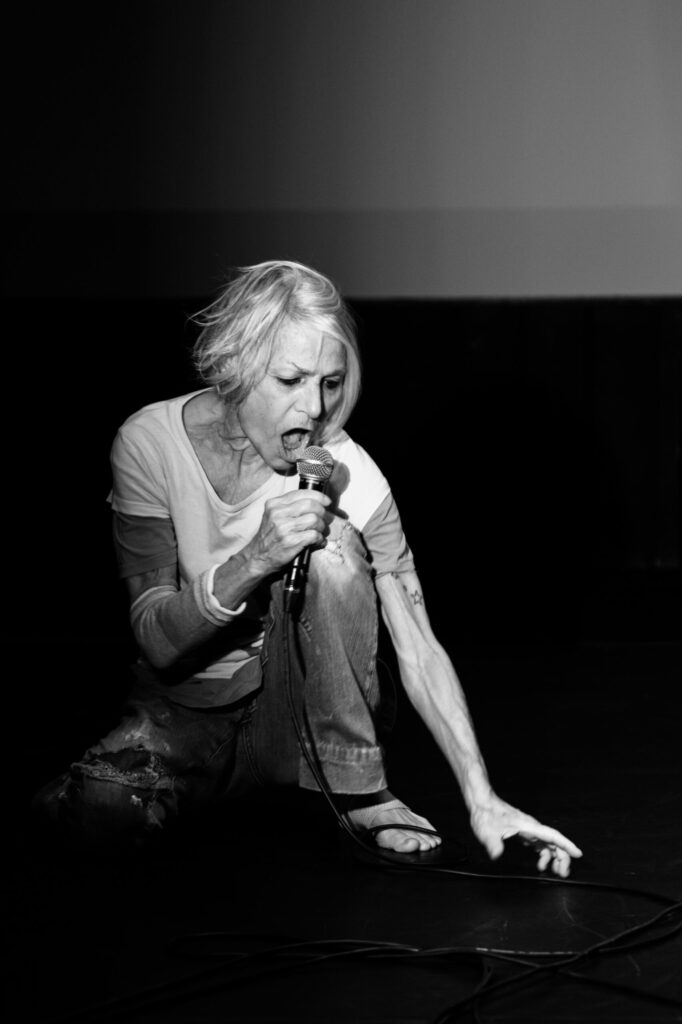
Quit? It’s the last thing on the mind of Katie Duck, the punk icon of multidisciplinary art and improvisation, born in California in 1951. She continues to question the status quo with tireless creative energy.
Her apartment in Amsterdam includes a top-floor studio with a beautiful wooden floor. The space has become her sanctuary, where artists gather twice a week and performances take place outside conventional venues.
Duck has been performing ever since she began as a child actor. In 1995, she founded the legendary improvisation collective MAGPIE in Amsterdam, driven by her passion for multidisciplinary improvisation—bringing together musicians, dancers, actors, and visual artists. She was also motivated by her curiosity about how spontaneous live interactions could create unique experiences worth sharing with an audience.
Making Decisions in Real Time
Since 2009, Duck has run the Summer Course Amsterdam, which will take place again this August. One point she emphasizes is that improvisation does not mean freedom.
“I’ve never seen improvisation as the opposite of composition. They’re the same discipline. If you study Baroque music, you’ll discover that improvisation exists there too. It’s about interpretation and developing your own voice while playing an instrument. In performance, it’s about training people to make intelligent decisions at the right moment. You’re not searching for freedom. You’re searching for the moment of composition.”
According to Katie Duck, performing means going beyond interpretation and technique to achieve transformation.
“It’s a discipline. You need technique, but the technique shouldn’t be visible. Walking is dancing, and if you learn to walk well, you learn to dance.”
She adds:
“I love how many options and choices there are. Accidents. Happy coincidences. To what extent can we integrate those into composition? When it happens, it’s magical—but the composition also has to have enough breathing room for that to occur.”
Making Space
Duck believes that trust in this process is essential.
“It simply happens. I don’t think it’s an analytical process, creatively speaking. I think it’s more about feelings. I always keep the audience in mind—not how they might judge the work, but what I invite them to experience together with me. You have to give them space.”
Only the people in the room truly bring a performance to life.
Over many years of teaching, Duck has developed numerous methods to unlock this kind of magic.
“I prefer games over rule-based exercises. Afterwards, you can create a piece based on what you’ve learned through play.”
Listening, she says, is the most important part of improvisation.
“Notice what your body is doing. What is going through your mind? How do you get yourself into a position where you become curious about your own body?”
Instead of getting caught up in hierarchies of movement, she focuses on awareness—listening carefully to yourself, your body, and the space around you. Not listening to her, Katie, but to yourself.
She practices this herself.
“I was a completely unsuccessful hippie. I was a very successful punk. I saw a band, and instead of becoming a groupie, I wanted to join them.”
“Humor Has to Be Simple”
One thing she insists on:
“I insist on humor. Humor has to be simple. Look into the darkness, and you’ll find the humor in it.”
For Katie Duck, laughter and lightness are essential. Otherwise, gatherings risk turning into events centered around a guru.
“And I don’t want to be responsible for that.”
Behind her rough laugh lies great sensitivity and a deep concern for community. Duck believes human connection matters more than anything else.
“Coming together is the very essence of what makes this profession possible. We live in an extremely conservative time. Idiotic heads of state are leading governments. We’re literally being governed by psychopaths.”
She doesn’t shy away from strong words.
She is deeply concerned that artists are increasingly forced to run their lives like businesses, while applying for grants becomes ever more bureaucratic. Duck tries to support younger artists by regularly offering studio and performance space to those without public funding.
“Being an artist is a way of life. It affects everything you do. Be careful about making the wrong compromises. If business overshadows your artistic work, you have a problem. But avoiding that is incredibly difficult.”
“Neuronal Madness”
Even so, she remains convinced:
“As an artist, you play an essential role in society.”
She means it sincerely, though she laughs as she adds:
“But it’s all just neuronal madness. How can anyone seriously make a living doing something like this? I just do it. I’ve done it all my life. What we do is pretty crazy. But you probably have to be a little crazy. And if you’re an artist, you can’t give it up. Because you simply are an artist.”
At a time when art is increasingly treated as a commodity, Katie Duck’s commitment to community, listening, and the intrinsic value of artistic creation feels as radical as it is necessary.
At 74, she is still bringing people together, creating spaces for others, and looking ahead—still punk, still uncompromising, and still, above all, an artist.
Translated from the English by Marc Staudacher.
Summer Course Amsterdam, August 17–22: “Multidisciplinary Workshop” with Katie Duck (August 17–18). Registration: www.summerimpro.com